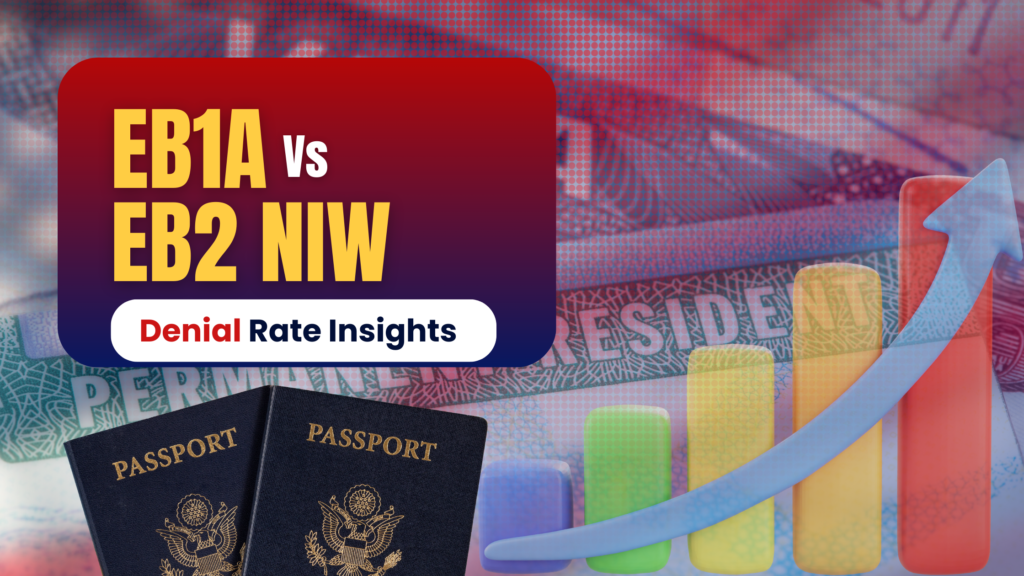
EB-1A vs EB-2 NIW Denial Rates: How to Make the Right Choice
If you’re considering applying for a U.S. employment-based green card without an employer sponsor, you’ve likely heard about EB-1A and EB-2 NIW. Both allow self-petition: in other words, you, the applicant, can file your own petition based on your achievements or proposed work. But choosing between them isn’t just about convenience — it’s about strategy. Recent data shows that approval and denial patterns are shifting significantly. Understanding those trends could make the difference between a successful petition and a frustrating denial or long wait.
In this post, we’ll break down the most recent available data, explain what’s changed, and help you evaluate which option may be better given your background, credentials, and goals.
What EB-1A Really Means and Who It’s Best For
EB-1A stands for Employment-Based First Preference: Extraordinary Ability.
You do not need an employer sponsor. You can self-petition.
The EB-1A category is meant for individuals who have reached a level of excellence that clearly sets them apart in their field. You can self-petition, and no employer sponsorship is required. To qualify, you must present strong evidence of your achievements, publications, awards, industry recognition, or meaningful contributions that show you are among the top performers in your profession. This path suits applicants who already have a well-developed record of success.
What EB-2 NIW Really Means and Who It’s Best For
The EB-2 NIW category also allows self-petition, but it evaluates a different standard. Instead of proving extraordinary ability, you must show that your work provides clear value to the United States on a national level. USCIS looks for strong indications that your future contributions will benefit the country, whether in research, public health, technology, social impact, or innovation. This option is ideal for applicants whose professional plans align with broader national interests.
EB-1A vs EB-2 NIW Denial Rate — What Recent Numbers Show (2024–2025)
Understanding the denial rate helps you decide which category fits your situation best. While USCIS updates numbers over time, recent available data paints a clear picture of trends.
Here is the simplified breakdown based on the most recent publicly available statistics:
- EB-1A approval has hovered between 60% and 70% in 2024–2025.
- EB-2 NIW approval has fluctuated more, with some periods dropping to the mid-40% range and others rising above 50%.
- EB-2 NIW has also experienced larger backlogs and more pending cases, which adds uncertainty for applicants.
What this means for you:
- EB-1A denial rates tend to be more stable, even though the category is stricter.
- EB-2 NIW denial rates vary more sharply, often due to tighter requirements for proving national interest.
The important thing here is not simply the percentage. It’s the trend.
NIW was once seen as the “easier” option. That is no longer true in every case.
Why EB-2 NIW Denial Rates Have Increased in Recent Years
The rise in EB-2 NIW denials may feel discouraging, but there are clear reasons behind it. Understanding them helps you prepare a stronger petition.
1. USCIS now requires more specific proof of national impact
General statements like “my work benefits the United States” no longer work. Officers want concrete examples: measurable contributions, documented improvements, or clear potential for nationwide influence.
2. The number of NIW applications has surged
More people are applying, especially in STEM fields. With higher volume comes stricter scrutiny.
3. Officers expect well-structured evidence and future plans
Petitions without clear project outlines, roadmaps, or expert support letters are now more likely to face denial or RFEs.
4. Backlog delays affect case outcomes
With large numbers of pending cases, USCIS becomes more selective about what gets approved quickly and what gets delayed or denied.
5. NIW expectations shifted after recent adjudication trends USCIS has signaled through its decisions that NIW should reflect genuine national importance not simply good research or professional contributions.
Why EB-1A Denial Rates Tend to Be More Predictable
Even though EB-1A has one of the highest eligibility standards, the way USCIS evaluates these petitions is more consistent. The criteria are clearly defined, and officers rely heavily on documented, measurable accomplishments rather than subjective interpretations. This makes the outcome more predictable for applicants who truly meet the requirement of extraordinary ability.
Several factors contribute to this stability:
- EB-1A is based on a proven track record, not on expected future impact. Officers evaluate what you have already accomplished, not what you plan to do.
- The evidence is highly objective, such as awards, publications, citations, leadership roles, and documented industry influence. These are easier to assess using established standards.
- The criteria have remained stable over time, which means applicants and consultants can prepare with a clear understanding of what USCIS expects.
- Future plans are not the driving factor, so there is less room for interpretation or uncertainty compared to NIW.
- Applicants with strong, well-documented portfolios tend to receive similar outcomes, because officers are evaluating comparable types of evidence.
In short, EB-1A is demanding but it rewards applicants who can clearly demonstrate extraordinary achievements through solid, verifiable documentation.
Common Mistakes That Lead to Denials
Errors in Both EB-1A and NIW
1.Vague writing or weak narrative
A poorly written or unclear narrative makes it difficult for officers to understand your accomplishments and the importance of your work.
2. Generic recommendation letters
Letters that lack specifics, measurable contributions, or personalized details fail to strengthen your petition.
3. Disorganized evidence
Submitting documents without logical structure or clear labeling forces officers to interpret your case themselves, increasing the risk of misunderstanding.
4. Overclaiming impact without proof
Statements about achievements or influence that are not supported by strong evidence can undermine your credibility.
Frequently Asked Questions
1. Is EB-2 NIW easier than EB-1A?
Not necessarily. NIW has experienced fluctuating approval rates and stricter scrutiny. EB-1A is harder to qualify for but more predictable once the standard is met.
2. Can I reapply if I get denied?
Yes. You can improve your evidence and file again. There is no waiting period imposed by USCIS.
3. Can I succeed without publications or awards?
Possible for NIW if your work has strong national importance. For EB-1A, these achievements significantly strengthen your case.
Summary
The choice between EB-1A and EB-2 NIW is not about which category is “easy.” It’s about understanding the standard, knowing where you stand, and preparing your evidence with intention. With denial rates shifting in 2024–2025, careful planning matters more than ever. If your strengths lie in major achievements and recognized excellence, EB-1A may give you more predictable results. If your work offers measurable value to the United States and serves the national interest, EB-2 NIW remains a powerful self-petition option. Whichever path you choose, the key is preparation and having the right guidance.
Contact our team to schedule a profile evaluation and get a clear, evidence-driven recommendation on the best path for your case.
For official information on the EB-2 and NIW process, visit the USCIS website.